
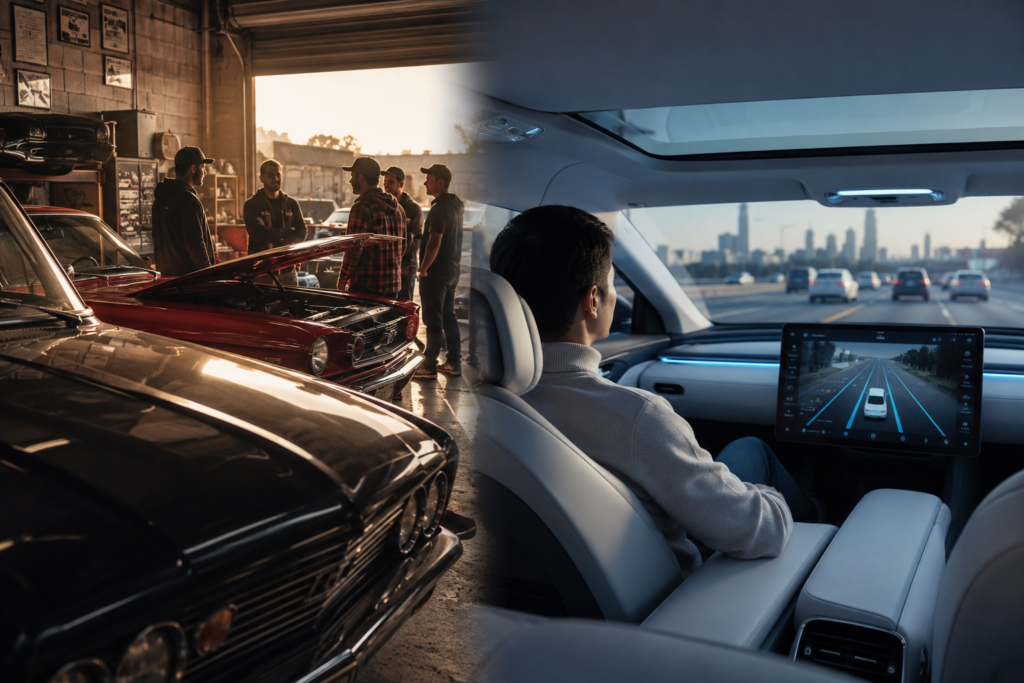
For more than a century, driving has represented far more than transportation. Cars have shaped identity, status, freedom and social belonging. Entire communities have formed around the experience of being behind the wheel — from weekend enthusiasts and modified car scenes to road-trip traditions and late-night meets in retail park car parks across the UK.
But as autonomous technology advances, the meaning of car culture itself may begin to change.
The automotive industry often frames self-driving systems in practical terms: safety, efficiency, congestion reduction and convenience. Yet the cultural implications are rarely discussed with the same seriousness. If driving gradually becomes optional rather than essential, what happens to the emotional attachment people have historically formed with cars?
The answer is unlikely to be simple. Car culture probably will not disappear, but it may evolve into something very different from the version that shaped previous generations.
Driving Has Always Been Emotional
For many motorists, driving is tied to memory and personal identity as much as utility.
Learning to drive has traditionally symbolised independence. First cars often carry emotional significance long after they become impractical or outdated. Road trips create rituals and shared experiences that feel deeply personal because the act of driving itself is part of the journey.
Enthusiast culture reflects this emotional connection clearly. People invest time and money into modifications, detailing, sound systems and styling choices not because they are necessary, but because vehicles function as extensions of personality.
Autonomous vehicles challenge that relationship by shifting attention away from the driver and towards the passenger experience. If the car becomes primarily a transport environment rather than something actively controlled, emotional priorities may change with it.
Future interiors could resemble lounges, offices or entertainment spaces more than traditional cockpits. That may appeal to commuters, but it alters the psychological role cars have historically played.
Enthusiast Communities May Become More Niche
There is a tendency to assume autonomous technology will eventually replace traditional driving altogether. In reality, cultural transitions rarely happen so cleanly.
Manual watches still exist despite smartphones. Vinyl records survived streaming. Film photography remains relevant despite digital cameras. Activities often become more culturally valuable once they are no longer necessary.
Driving may follow a similar path.
As automation becomes more common in everyday transport, enthusiast driving could evolve into a specialised recreational culture. Track days, classic car ownership, countryside touring and analogue sports cars may gain stronger cultural appeal precisely because they offer something increasingly rare: direct human control.
Rather than disappearing, enthusiast communities could become more identity-driven and experience-focused.
This may already be happening in parts of the EV era. Many younger drivers are less interested in engine specifications alone and more focused on aesthetics, individuality and lifestyle presentation. Visual identity has become central to modern automotive culture, particularly online.
That is partly why personalisation remains important even as cars become more software-led. Exterior styling, wheel choices and subtle visual details still help owners distinguish their vehicles from increasingly standardised designs. Companies like Number 1 Plates sit within this broader movement towards automotive individuality, where drivers continue searching for ways to make vehicles feel personal in an increasingly digital landscape.
Road Trips Could Change Completely
One of the biggest cultural shifts may involve the road trip itself.
Traditionally, long-distance driving has carried a sense of immersion and engagement. The route matters. The driver matters. Stops along the way become part of the story.
Autonomous travel changes the dynamic because time inside the vehicle becomes psychologically detached from the act of movement. Journeys may begin to feel more like passive transit than active experience.
For some people, that will be a welcome improvement. Long motorway drives are tiring, stressful and monotonous. Removing the workload allows passengers to work, sleep or consume entertainment instead.
Yet something may also be lost in the process.
Driving currently creates moments of unpredictability and interaction with surroundings. Weather conditions, unfamiliar roads and spontaneous detours all contribute to the emotional texture of travel. Fully autonomous systems prioritise optimisation and predictability, potentially making journeys feel more uniform.
The question is whether convenience eventually outweighs emotional engagement for most people.
The Status Symbol of the Future May Not Be Performance
Car culture has long associated status with performance, speed and engineering. Autonomous mobility could shift those values dramatically.
If vehicles handle acceleration, braking and navigation independently, performance may matter less to mainstream buyers than comfort, software integration and interior experience.
This would mirror changes already visible in consumer technology. People increasingly value seamless interfaces and connected ecosystems over raw mechanical capability.
In that environment, prestige may become tied to design minimalism, digital ecosystems and passenger experience rather than horsepower.
However, there may also be resistance to that transition. Performance cars have historically represented aspiration because they require skill and engagement. Removing the human element risks making driving feel emotionally flatter, even if technologically superior.
Manufacturers will likely spend the next decade balancing these competing expectations: convenience for mass-market users and emotional authenticity for enthusiasts.
Social Media Will Shape the Transition
Modern car culture already exists heavily online.
Platforms like TikTok, Instagram and YouTube have transformed how trends spread through enthusiast communities. Visual presentation often matters as much as technical knowledge, and aesthetics frequently outperform engineering discussion in terms of engagement.
Autonomous technology may accelerate this shift further.
As cars become more digitally integrated, ownership experiences may focus increasingly on interior ambience, design customisation and lifestyle branding rather than driving dynamics alone. Vehicles could function more like mobile personal spaces than machines built around driver involvement.
At the same time, traditional enthusiast communities may become more protective of analogue driving culture. Manual gearboxes, naturally aspirated engines and mechanically focused cars may gain symbolic value as representations of authenticity.
This cultural divide could define automotive identity over the next twenty years.
A Future Where Driving Becomes Optional
The most significant cultural change autonomy introduces is choice.
For most of automotive history, driving has been necessary. In the future, it may become optional for large parts of society.
That distinction matters because optional activities often become more emotionally meaningful. People may choose to drive not because they must, but because they genuinely enjoy the experience.
If that happens, car culture could become smaller but more passionate. The everyday commuter may disengage from driving entirely, while enthusiasts treat it more like a hobby or craft.
Autonomous technology will undoubtedly reshape mobility. But human attachment to cars has never been based purely on practicality. It comes from emotion, identity and experience — qualities that are harder to automate than steering and braking.
The future of car culture may therefore depend less on whether vehicles can drive themselves, and more on whether people still want to drive at all.