
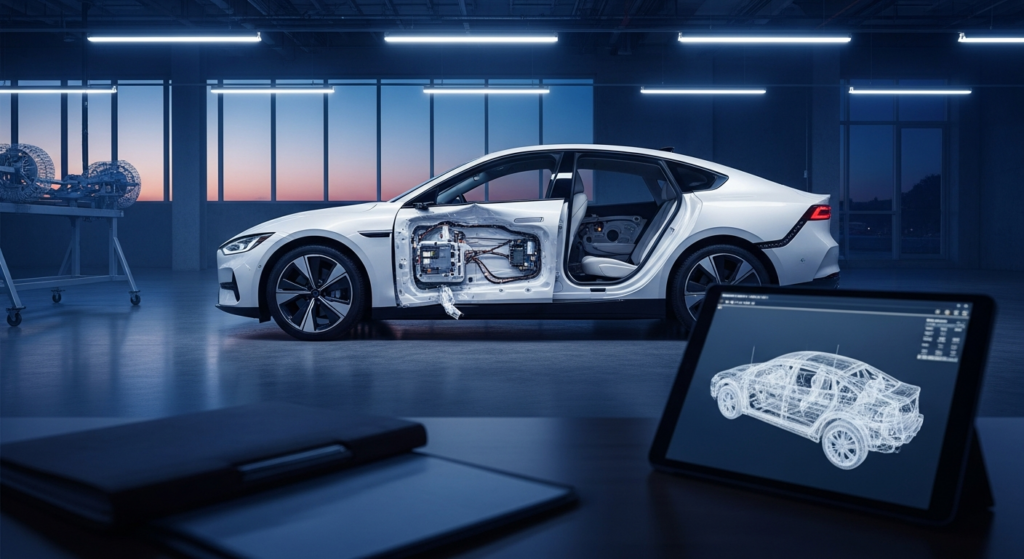
Electric vehicles are marketed as the safest cars on the road, loaded with advanced driver-assistance systems and cutting-edge tech. But all that complexity introduces new failure points, and some of them are potentially catastrophic.
High-profile incidents tell the story: electronic door latches locking people inside after a power loss, critical safety software glitching at the worst possible moment. If the technology built to protect you breaks down during a crash, who actually pays for the consequences? This guide untangles the legal liability, separating driver error from product defects so you know who’s accountable when a vehicle’s smart features fail.
Driver Negligence vs. Product Defects
Two Sides of Every Modern Crash Claim
After any vehicle crash, step one is figuring out what caused it. With electric and semi-autonomous vehicles, that’s no longer straightforward. The cause might be simple human error, a complex tech failure, or some mix of both. Understanding the line between driver negligence and product liability is the foundation of any successful claim.
The Established Rules of Driver Fault
Driver negligence is still the most common cause of traffic accidents. The concept is simple: if your careless or reckless actions directly caused a crash, you’re financially responsible. And the numbers are staggering. In 2023 alone, an estimated 40,901 people died in motor vehicle crashes, and another 2.4 million were injured.
The U.S. Department of Transportation estimated the annual economic cost of these crashes at $340 billion in 2019. That figure has likely only grown.
Here are several of the most typical examples of negligent driving:
- Distracted driving: In 2022, distracted drivers caused crashes that killed 3,308 people and injured an estimated 289,310.
- Speeding: Driving too fast for conditions was a factor in 29% of all traffic fatalities in 2023.
- Driving under the influence: Operating a vehicle while impaired by alcohol or drugs significantly slows reaction times and clouds judgment.
- Violating traffic laws: Failing to yield, running stop signs, or making improper turns are clear-cut negligence cases.
When the Vehicle Itself Is the Problem
Product liability law holds manufacturers and sellers responsible for putting a defective product into consumers’ hands. When an EV’s safety feature fails, the focus shifts from the driver’s behavior to the vehicle’s integrity. This is a growing concern; NHTSA data shows that battery-related recalls keep rising as a share of all EV safety actions.
Three primary types of defects can trigger a product liability claim:
- Manufacturing defect: A flaw that happens during production, making one specific vehicle unsafe. Think of the Jaguar I-Pace recall, where a folded anode tab in a battery cell (a production error) could cause thermal overload and fire.
- Design defect: A flaw baked into the product’s blueprint, making it unreasonably dangerous even when manufactured perfectly. Class-action lawsuits against Tesla allege this with its electronic door handles, which may become inoperable after a power loss, trapping occupants inside.
- Warning or instruction defect: This involves failing to provide adequate warnings about how to safely use the product. It could apply if a vehicle’s manual doesn’t clearly explain how to operate a mechanical emergency door release. The Tesla lawsuits highlight this issue, noting the rear release requires pulling back the carpet to access the cable.
Driver Negligence vs. Product Liability in an EV Crash
| Aspect | Driver Negligence (At-Fault) | Product Liability (Defective Vehicle) |
| Primary Cause | Driver’s actions or inactions (speeding, distraction) | Defect in the vehicle’s design, production, or safety warnings. |
| Who Is Liable? | The at-fault driver | Manufacturer, component supplier, or software developer |
| Key Evidence | Police reports, witness statements, traffic camera footage | “Black box” data, expert analysis, recall notices, internal company documents |
| Real-World Example | A texting driver rear-ends the car ahead | Electronic door latch fails post-collision, trapping occupants |
The Chain of Responsibility: Who Can You Hold Liable?
Identifying the Parties
When a safety feature fails, blame rarely rests with a single entity. A modern EV is a complex assembly of hardware and software from dozens of suppliers. The legal framework lets victims seek compensation from multiple parties along the supply chain, and that’s critical for making sure you get a full and fair recovery.
The Vehicle Manufacturer
The automaker (Tesla, Ford, Volvo, etc.) is the most visible defendant in a product liability lawsuit. They carry ultimate responsibility for the design, assembly, and testing of the final product.
Consider what happened with Xiaomi: after public scrutiny over fatal crashes involving door failures, the Chinese automaker established a safety advisory committee and announced an upgraded SU7 model with a backup power supply for the doors. That kind of action shows the direct pressure manufacturers face to prove their technology is safe.
Component and Software Suppliers
An EV is only as safe as its weakest part, and that weak link might not come from the automaker. It could be a battery manufacturer whose cell defect leads to a fire, a software developer whose buggy driver-assistance code causes an accident, or a hardware supplier with a faulty sensor.
International laws are catching up. For example, Thailand’s Product Liability Act specifically identifies vehicle manufacturers, battery suppliers, and software developers as “potentially liable parties” in a product failure. Figuring out fault in these layered cases requires deep technical and legal expertise. If you’re trying to navigate a car accident claim, it’s worth consulting with professionals who understand both traditional accident reconstruction and emerging vehicle technologies.
Importers, Distributors, and Dealerships
Every entity in the chain of commerce can potentially be held liable for injuries caused by a defective product. That includes the national importer, the regional distributor, and the local dealership that sold you the vehicle. This principle makes sure you have multiple avenues for recourse, which matters a lot if the original manufacturer is based overseas.
How to Document a Safety Feature Failure
What to Do Right After the Crash
The moments after a crash are disorienting. But the steps you take can make or break your legal case. If you suspect a vehicle feature failed and contributed to the accident or worsened your injuries, documentation is everything. This evidence will be vital for proving your claim and holding the right parties accountable.
At the Scene
First, prioritize safety. Check for injuries and call 911 right away. If it’s safe, move your vehicle out of traffic.
When the police arrive, report exactly which features you believe failed. Be specific: “The automatic emergency braking didn’t engage,” or “I couldn’t open my door using the electronic release after impact.” Getting this detail into the official police report can be invaluable later.
A Step-by-Step Evidence Checklist
Proving a complex tech failure takes meticulous evidence collection. Here’s how to put together the most compelling case possible:
- Photograph and video everything. Use your phone to document the scene thoroughly. Photograph the damage on every vehicle from several different angles. Crucially, photograph the interior of your car, focusing on whatever you believe failed: the electronic door handle, an unresponsive touchscreen, or error messages on the dashboard. A short narrated video describing the failure as you experienced it is also helpful.
- Preserve the vehicle. This is the single most important step in a product liability case. Tell your insurance company and the tow truck driver that the vehicle must not be repaired or destroyed. Your legal team will need automotive engineers to inspect the hardware and download data from the event data recorder (EDR), sometimes called the “black box.”
- Gather witness information. Collect names, phone numbers, and addresses from everyone who saw what happened. That includes other drivers, passengers, and bystanders who may have watched you struggle to exit the vehicle or saw a driver-assistance system behave erratically.
- Obtain all official reports. Request a copy of the police report as soon as it is released. Keep a detailed file of all medical records, bills, and receipts tied to the accident.
- Check for recalls and TSBs. Research whether your vehicle’s make, model, and year has been subject to any recalls or technical service bulletins (TSBs) related to the issue you experienced. Recent recalls, like Ford’s Explorer suspension action and Volvo’s EX30 battery overheating recall, show that this information is often public and can serve as powerful evidence.
Where Innovation Meets Accountability
As vehicles evolve into sophisticated electronic platforms on wheels, how we think about accident liability has to evolve with them. The convenience of electronic doors and advanced driver-assistance systems comes with a non-negotiable expectation: they must work reliably, especially in an emergency.
When they don’t, legal responsibility extends beyond the driver to the entire network of manufacturers, designers, and suppliers who brought the tech to market. So what does that mean for you? Understanding the line between human error and technological failure, and knowing how to document it, is your first step toward accountability and fair compensation.