
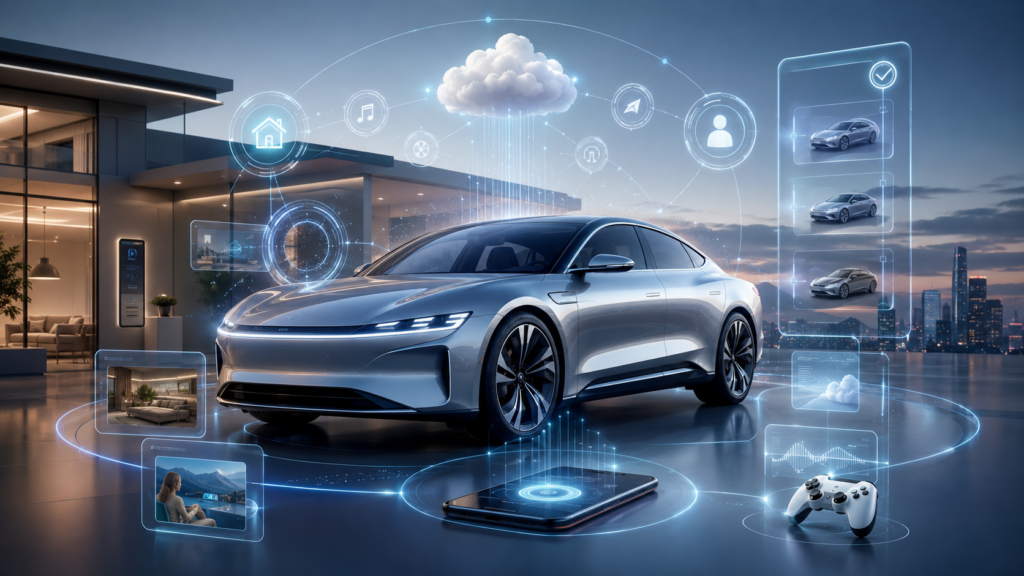
For most of automotive history, cars were engineered, sold, and maintained as mechanical products. Once purchased, they changed only through physical modification or wear. That model is now being reshaped by a quieter but more fundamental shift: the increasing alignment between automotive brands and consumer technology companies.
What emerges from this shift is not just a new set of features, but a new operating logic for mobility itself. Vehicles are becoming connected systems, updated continuously, and increasingly defined by software as much as hardware.
From Machines to Managed Platforms
Modern vehicles no longer behave like static machines. Instead, they function as managed platforms that evolve over time. This transformation is driven by three converging forces: connectivity, onboard computing power, and cloud-based infrastructure.
Connectivity allows vehicles to communicate with external systems in real time. Onboard computing enables complex data processing within the car itself. Cloud infrastructure ties everything together, allowing manufacturers to deploy updates, collect performance data, and refine systems remotely.
The result is a product that is never fully “finished”. A car can now receive new features months or years after it leaves the factory, from infotainment upgrades to refinements in driver assistance systems.
This approach mirrors the consumer technology sector, where devices are expected to improve through updates rather than remain fixed at the point of purchase.
The Rise of Automotive Ecosystems
The traditional automotive value chain placed the vehicle at the centre of the experience. Today, that centre is expanding into an ecosystem.
Manufacturers increasingly operate app stores, subscription services, charging networks, and digital dashboards that extend beyond the vehicle itself. Navigation, entertainment, maintenance alerts, insurance integration, and remote diagnostics are now part of a broader connected environment.
In practice, this means drivers are no longer simply interacting with a car. They are interacting with a layered system of services that surrounds it.
This shift is especially visible in the electric vehicle sector, where software plays a central role in everything from energy management to route planning. But it is also spreading across hybrid and even internal combustion platforms as manufacturers standardise connected architectures.
The long-term implication is clear: brand loyalty will be shaped not only by driving experience, but by the quality of the digital ecosystem that supports it.
Subscription Logic and the Redefinition of Ownership
One of the most visible signs of convergence between mobility and consumer technology is the rise of subscription-based access models.
Rather than treating mobility as a one-time purchase, some manufacturers and third-party providers are offering flexible access to vehicles through monthly payments that include insurance, servicing, and upgrades. Users can switch between models depending on need, effectively treating mobility as a service rather than a fixed asset.
This does not replace traditional ownership, but it introduces an alternative framework where access becomes more important than possession.
In consumer technology, this shift has already occurred. Streaming services replaced physical media ownership. Cloud storage replaced local file management. Software subscriptions replaced perpetual licenses.
Automotive design is beginning to follow a similar trajectory, albeit more slowly due to regulation, infrastructure, and cultural attachment to cars as physical assets.
Software-Defined Features and the New Value Proposition
As vehicles become more digitally enabled, software is emerging as a key differentiator. Features that were once purely mechanical are now increasingly defined by code.
Adaptive cruise control, lane-centering systems, predictive energy management, and even performance tuning can be adjusted or enhanced through software updates. In some cases, features are unlocked after purchase, shifting the concept of what is included in the base vehicle.
This creates a layered value proposition. Two identical vehicles may differ significantly in functionality depending on their software configuration and subscription status.
For manufacturers, this introduces recurring revenue streams and ongoing customer engagement. For consumers, it introduces both flexibility and complexity, particularly when features are tied to ongoing payments.
The automotive industry is therefore adopting a model long established in consumer technology: hardware provides the foundation, while software defines the experience.
Identity, Personalisation, and Digital Expression
Despite the increasing digitalisation of mobility, physical identity remains important in car culture. Vehicles are still deeply tied to personal expression, particularly in how owners choose to customise and present them.
However, the nature of personalisation is changing. While physical modifications such as wheels, wraps, and interior adjustments remain popular, digital customisation is becoming equally significant. Dashboard layouts, ambient lighting profiles, infotainment themes, and driver settings now allow individuals to tailor the driving experience in ways that were previously impossible.
This creates a dual-layer identity: one physical, one digital.
The influence of social media has accelerated this trend. Cars are no longer just transport; they are also visual statements shared and curated online. As a result, even subtle details contribute to how a vehicle is perceived.
In this context, registration identifiers still play a visible role in vehicle identity. Subtle physical distinctions remain part of how drivers personalise their cars within regulatory limits, and businesses such as Plates Express exist within this broader landscape of automotive identity and presentation.
Mobility as an Ongoing Relationship
The convergence of mobility and consumer technology ultimately reframes the relationship between drivers and vehicles.
Rather than a single transaction followed by static ownership, mobility increasingly resembles an ongoing interaction. Vehicles are updated, reconfigured, and integrated into broader digital environments throughout their lifecycle.
Manufacturers, in turn, maintain a continuous relationship with users through software updates, service platforms, and connected features. This allows for more responsive design but also introduces a shift in control, where part of the driving experience is shaped long after purchase.
This ongoing relationship is closer to how people interact with smartphones and digital services than traditional mechanical products.
Conclusion
The automotive industry is undergoing a structural transformation driven by its convergence with consumer technology. Vehicles are no longer defined solely by engineering and manufacturing but by connectivity, software, and ecosystem integration.
This does not eliminate the importance of physical design or driving dynamics, but it expands the definition of what a car is. It becomes a platform, a service node, and a continuously evolving digital product.
As this convergence continues, the distinction between automotive brands and technology companies will likely become less clear. What remains constant is the central role of mobility in everyday life—only now expressed through systems that are more connected, adaptive, and software-driven than ever before.